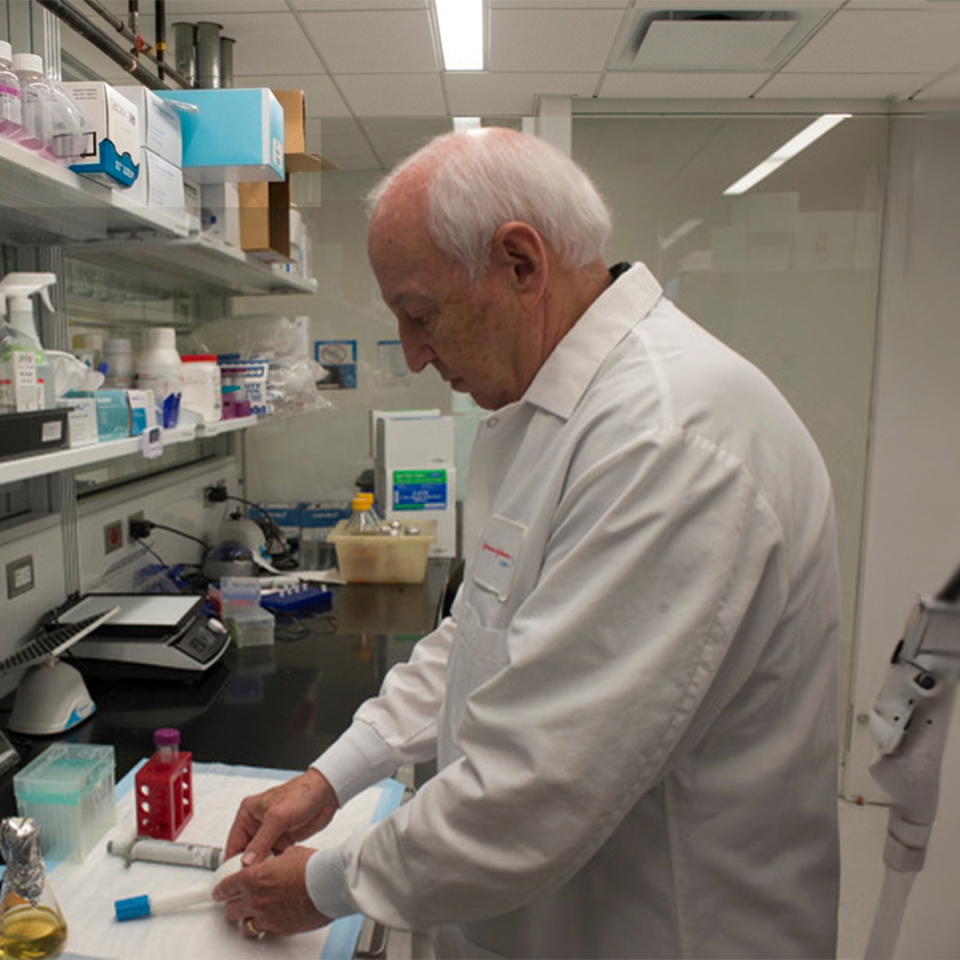




The diagnostics industry has a comfortable story about where errors come from, and it is mostly wrong. Clinical misjudgment gets the blame, the malpractice attention, and the training budgets. But the failure often happens long before a physician reads a result, in the gap between the patient and the laboratory bench: a sample that sat too long, a specimen that degraded in transit, a workflow built for an era when a two-day turnaround was acceptable. Dr. Leonard E. Weisman, Founder and Chief Technology Officer of LabReady, argues that the industry has stopped registering this as a problem at all. That is precisely why he treats it as a commercial opportunity. “Slow transport, degraded specimens, and outdated laboratory workflows are quietly costing lives, and the industry has accepted it as normal for far too long,” he says. His position carries weight because he has done this before. Weisman invented the first two antiviral drugs for respiratory syncytial virus (RSV), which became the foundation of MedImmune, later acquired by AstraZeneca for $15.6 billion. He is now commercializing the LabReady Multi-Point qPCR AI platform, a pocket-sized rapid multiplex qPCR (quantitative polymerase chain reaction) diagnostic with onboard AI. His framework for getting a breakthrough diagnostic from bench to market rests on three principles, and each one cuts against how most medical device companies operate.
Solve A Problem The Industry Has Stopped Seeing
Most diagnostic startups begin with a capability and go hunting for an application. A new sensor, a cheaper assay, a faster chemistry, and then a market map drawn after the fact. Weisman inverts the sequence. “Real innovation does not start with a new gadget,” he says. “It starts with a failure everyone has learned to live with.” The distinction matters commercially, not just philosophically. A company built around a gadget competes on specifications against incumbents with deeper pockets. A company built around a tolerated failure competes against nothing, because by definition no one else has named the problem.
For Weisman, that failure was specific and clinical. “For me, that was watching babies misdiagnosed because of how samples were handled,” he says. Four decades of neonatology gave him a vantage point most engineers never get: he saw the downstream human consequence of an upstream logistics decision, repeatedly, until the pattern became impossible to ignore. “If you can name the silent failure, you can build a company that fixes it.” The hard part is the naming. Silent failures stay silent because every participant in the chain has rationalized them as somebody else’s constraint. The courier blames the distance, the lab blames the courier, the clinician blames the lab, and the patient absorbs the cost. Founders who can trace that loop back to its origin are holding a map of an uncontested market.
Build For Where Care Happens
The second principle is where most diagnostic companies lose their economics. Central laboratory infrastructure is enormously capable and almost entirely misplaced relative to the moment a clinical decision gets made. A result that arrives after the physician has already chosen a treatment is a historical document, not a diagnostic. “A diagnostic only matters if it reaches the patient in time,” Weisman says.
That reframing changes the entire product specification. Instead of optimizing for throughput and analytical depth, you optimize for proximity and speed. “That means designing for the physician’s office, the emergency room, the pharmacy, the farm, not just the central lab,” he says. The inclusion of the farm is deliberate and worth pausing on. It signals a market definition that extends past human clinical medicine into veterinary and agricultural testing, where the same logistics failure exists with even less infrastructure to compensate for it. Decentralizing accurate testing does two things at once. “When you put accurate testing where decisions are made, you change outcomes. You change economics.” Those are not separate claims. Faster, more accurate point-of-decision testing reduces empirical treatment, unnecessary admissions, and the cascading cost of acting on incomplete information. The clinical case and the reimbursement case become the same case, which is the only condition under which a new diagnostic gets adopted at scale.
Lead With The Science And Let The Results Recruit Your Believers
The third principle is a direct rejection of how early-stage medical technology is typically marketed. Pitch decks lead with market size, category disruption, and the inevitability of the technology curve. Weisman’s position is that none of it moves the people whose decisions determine whether a diagnostic reaches patients. “Investors, partners, and regulators do not follow hype,” he says. “They follow data, patents, and proof.”
Regulators in particular are immune to narrative, which makes them a useful filter on everything else. A company that builds its evidence base to satisfy a regulatory reviewer has, almost incidentally, built the evidence base a serious investor and a clinical partner both require. “Build the evidence first, and the right capital and the right people will find you,” Weisman says. This is a sequencing argument as much as a credibility one. Capital raised ahead of proof arrives with expectations that distort the science; capital raised behind proof arrives on terms the founder can live with. Weisman’s broader point is that commercialization is not a stage that follows discovery. “Breakthrough diagnostics do not get commercialized by accident. They get commercialized by physicians, scientists, and operators who refuse to accept the status quo.” The refusal is the asset. Everything else is execution.
Follow Dr. Leonard E. Weisman on LinkedIn for more insights on diagnostic innovation, point-of-care testing, and commercializing breakthrough medical technology.